Chorniatyn
Neo-Gothic
Ignacy Witosławski
Mykola Lvov
Maria Mikhailovna Lvova
Henryk Ittar
Dionysius McClair
estate park
green tourism
palaces of Vinnytsia region
Object Overview
The Witosławski-Lvov Palace in Chorniatyn is one of the most distinctive historic estates in Vinnytsia region, where the architectural image of the palace is combined with a park, a quiet rural landscape, and a sense of unhurried contact with the place. For a green tourist, it is not only a monument, but also a route into an environment in which cultural heritage is read through trees, alleys, facades, silence, and the scale of the landscape.
What kind of location is this?
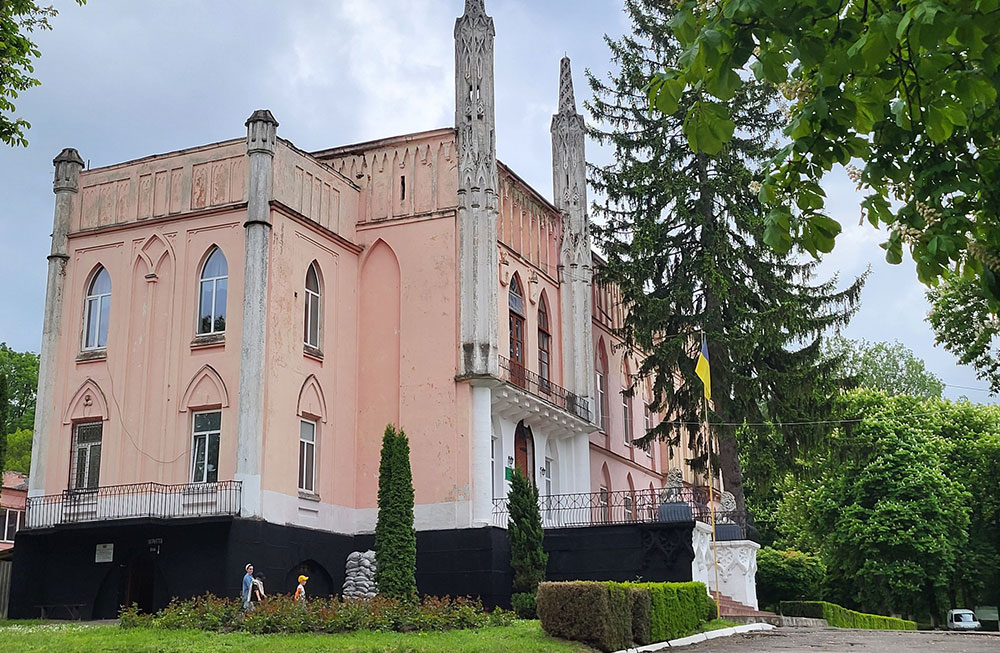
This is a palace-and-park complex in the village of Chorniatyn, Zhmerynka district. In available sources, the site is described as a Neo-Gothic palace of the first half of the 19th century associated with the Witosławski and Lvov families. Today the building is not a museum stage set: it retains a living function, as it houses Cherniatyn Professional College.
Why is the site important for green tourism?
The palace in Chorniatyn is interesting not only for its architecture. Its value for travelers is shaped by the combination of three layers: historical, landscape, and route-based. It is a site for those who seek not event-driven noise, but a calm cultural trip with the opportunity to see an old park, understand the spatial logic of the estate, and compare it with other residences of Podillia.
Visit format
The optimal format is a daytime trip focused on the exterior view of the palace, a slow walk through the park landscape, photo documentation of facade details, and inclusion of the site in a broader route of estates in Vinnytsia region. For indoor visits, visitors should keep in mind that the complex is used by an educational institution.
Photos
History
Origin of the estate
In available sources, the construction of the palace in Chorniatyn is usually dated to the 1820s or around 1830. The complex emerged as a noble residence of the Witosławski family. This stage is associated with the formation of the main architectural image of the palace, which quickly became a notable phenomenon in the estate culture of Podillia.
The Witosławskis and the Lvovs
The history of the site has two main family lines. Initially it belonged to the Witosławskis. Later the estate passed to the Lvov family. According to materials on the history of the college, Mykola Lvov owned the estate until 1887, and after him it was managed by Maria Mikhailovna Lvova until 1917. This is why the current name of the palace combines both families.
Post-revolutionary and Soviet period
After the revolutionary events and the change of the social order, the estate complex lost its original aristocratic function. Part of the decoration was lost, and the economic and representative role changed. At the same time, it was precisely the adaptive use of the complex in the Soviet period that kept the building from turning into ruins.
Educational function and current condition
Since 1922, the estate has become the basis of a new agricultural and educational center. Later an agricultural educational institution was formed here. The current use of the palace by the college is a key factor in the preservation of the building. This does not mean that full restoration has been completed, but it explains why the complex has survived in a more intact condition than many other Podillia residences.
Historical value
From a historical point of view, the Witosławski-Lvov Palace is an important testimony to how, in Podillia in the first half of the 19th century, a noble space was formed with a distinct European stylistic language, a park composition, and a local adaptation of romantic architectural models.
Architectural Features
Style and composition
The palace in Chorniatyn is most often described as Neo-Gothic. At the same time, its plasticity shows an eclectic quality typical of estate architecture in the Romantic era. In sources, Henryk Ittar is named as the likely author of the design. It is important to preserve exactly this cautious formula, because the issue of authorship is presented not as an indisputable fact, but as a professional attribution.
Facades and vertical accents
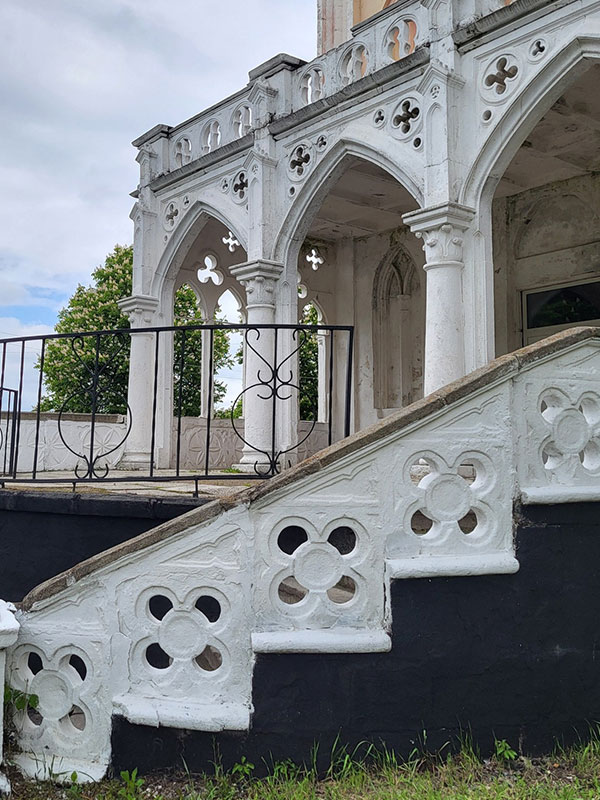
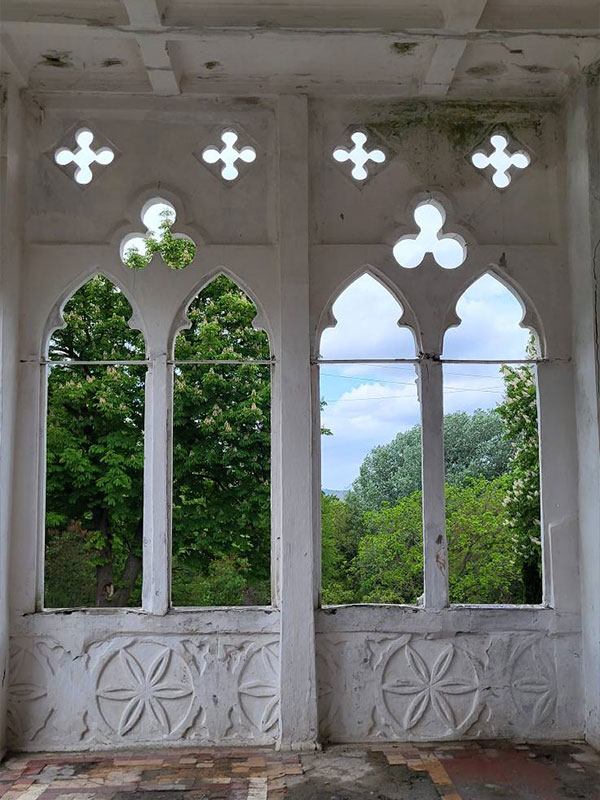
The architectural image of the palace is built on pronounced verticalization. Descriptions mention a high attic, pointed motifs, decorative gables, crenellated finishes, and pinnacles. These elements create a sense of romanticized “castle-like” imagery, thanks to which the building is perceived not simply as a manor house, but as a scenographic palace object.
Entrance group and preserved details
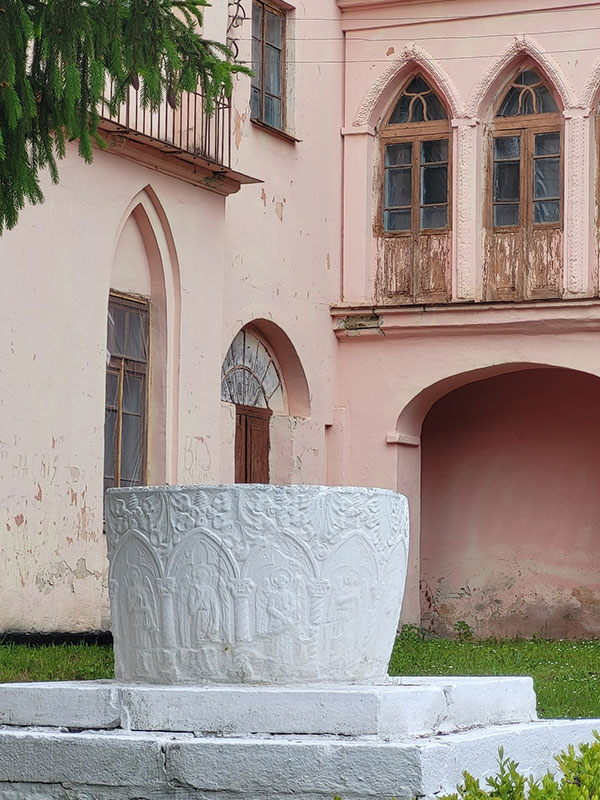
One of the best-known visual signs of the palace is the lions at the entrance. Sources also mention granite steps, stone vases, and individual heraldic and decorative motifs. This is important for tourism-related interpretation because such details function as markers of the site’s recognizability.
Interiors
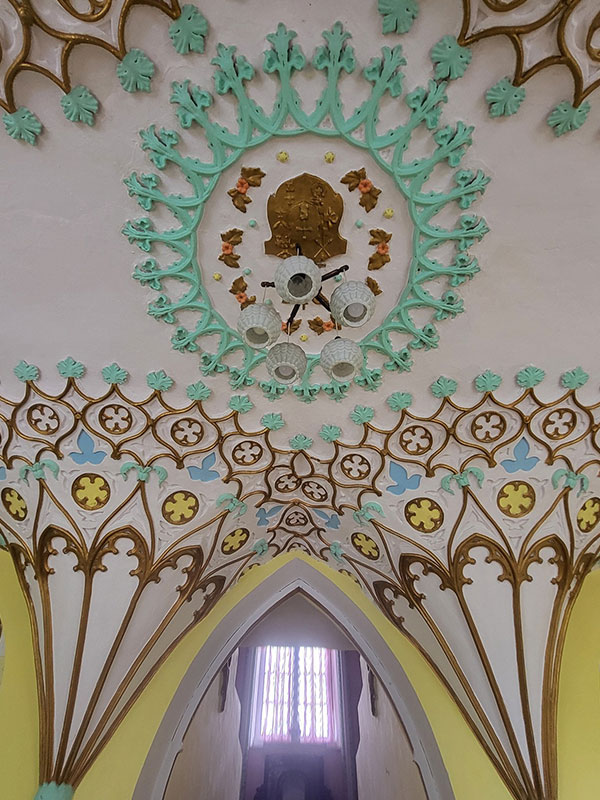
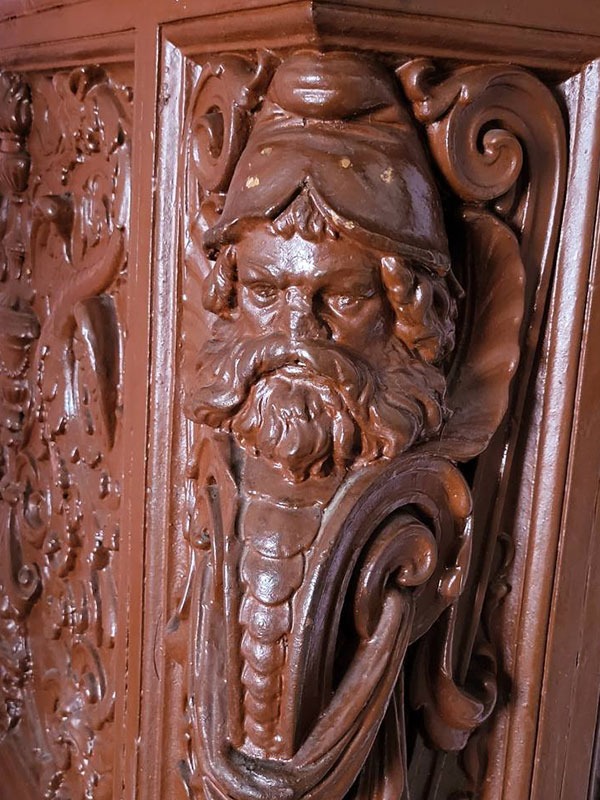
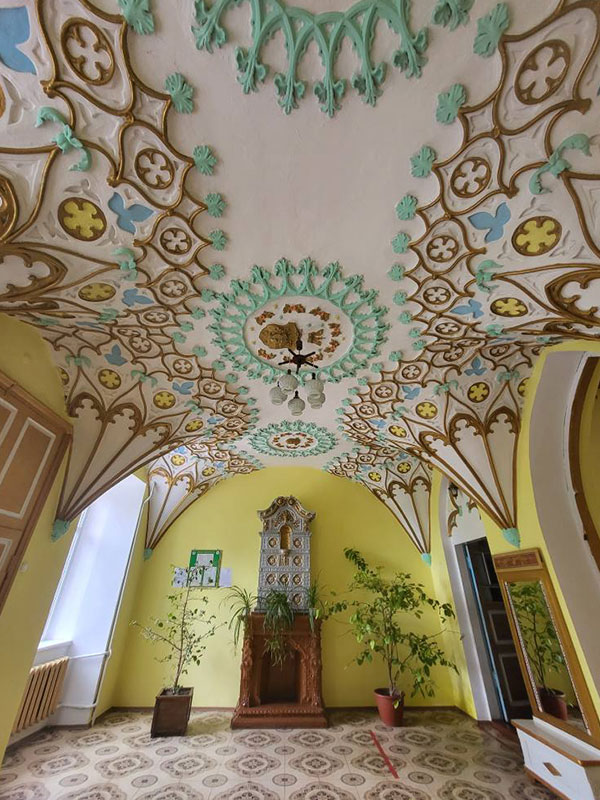
Despite losses, part of the historic interior décor has survived. Descriptions include vaulted ceilings with floral and geometric motifs, stucco work, a fireplace, tiled stoves, floor tiles, and elements of the staircase design. For analytical reading of the site, this means that the value of the palace lies not only in its facades, but also in a fragmentarily preserved artistic interior environment.
Cultural value of the architecture
The architectural value of the palace lies in the combination, rare for the region, of a Neo-Gothic language with the local estate context. For Vinnytsia region, where Classical complexes are more widely represented, Chorniatyn is important precisely as a different type of aristocratic residence — more romantic, more камерний, and more closely connected with the landscape atmosphere.
Natural Surroundings
The park as part of the primary entity
The Chorniatyn Palace should not be described separately from its park. For green tourism, the park is not an addition, but a full part of the location. Sources indicate that the park was laid out before the construction of the palace, that it is associated with the name of Dionysius McClair, and that its plantings include more than one hundred species of trees and shrubs.
Landscape value
The estate landscape works according to the principle of slow perception. What matters here is not one panoramic point, but a sequence of impressions: the facade in a green setting, the boundary between architecture and old plantings, the rhythm of the alley, the feeling of open space. This structure is exactly what makes the site suitable for walking, photography, and contemplative tourism.
What a green tourist gets
For the green tourism audience, Chorniatyn is attractive because it allows a combination of cultural interest with a gentle natural experience. It is a place for a slow route, not for a quick check-in. Seasonal changes in the park, photography of architectural details in natural light, and combining the trip with other estate sites in Vinnytsia region are all appropriate here.
Environmental etiquette for visiting
The location requires respectful tourist behavior: no excessive noise, no littering, no interference with the historic environment, and no unauthorized access to restricted areas. For green tourism this is essential, because the value of the place directly depends on preserving its landscape silence and historic fabric.
Tourist Infrastructure
Location and basic accessibility
The palace is located in the village of Chorniatyn, at 28 Hrafa Lvova Street. This is a site suited to an individual trip by car or as part of a local route from Vinnytsia and Zhmerynka. It can be integrated into a thematic tour of the estates of Vinnytsia region.
Current use of the site
The building houses Cherniatyn Professional College. For a tourist this means two things. First, the site is not a classic museum with a guaranteed visit scenario. Second, the continuing function of the institution supports the viability of the complex.
Practical visit scenario
The most realistic scenario is an exterior inspection of the facades, a walk around the palace, familiarization with the park environment, photo documentation of details, and a short historical accompaniment in the format of an independent route or an author-led regional tour. Before traveling, it is worth clarifying the conditions of access to the grounds and the possibility of viewing the interiors.
Who the location suits
The site is suitable for cultural travelers, admirers of estate architecture, photographers, small weekend groups, participants in slow travel routes, and tourists who appreciate small historic places that are not overloaded with mass traffic.
What to keep in mind
Chorniatyn should not be marketed as an “attraction with a full service package.” The strength of the location lies not in entertainment, but in atmosphere, authenticity, and the material memory of the place. This is exactly how it should be positioned both in the text and in the route.
Expert Analysis
Analytical conclusion 1
The Witosławski-Lvov Palace in Chorniatyn is valuable not only as an individual architectural object, but as an integral cultural landscape. Its strength lies in the combination of “palace + park + living function.” Many residences of Podillia have survived only fragmentarily or turned into decorative shells without an environment. Chorniatyn, by contrast, can still be read as a place where architecture has not yet completely separated from its natural framework.
Analytical conclusion 2
For SEO and content architecture, it is important not to reduce the location to a single template of an “old palace.” The primary entity here should be revealed through secondary entities: Neo-Gothic style, the Witosławskis, the Lvovs, the park, Dionysius McClair, surviving interior fragments, educational function, preservation through adaptive use, and the site’s place in the regional line of estates in Vinnytsia region. It is precisely this entity-based approach that makes the material convincing both for the reader and for search engines.
Positioning conclusion
Chorniatyn should be positioned as a камерна historic and landscape location for green and cultural tourism rather than as a mass excursion platform. This is its market distinction: what works here is not scale, but atmosphere; not the number of services, but the quality of the experience.
Comparative Table with Other Estates of the Region
| Site | Location | Style / period | Natural environment | Current use | Value for a green tourist |
|---|---|---|---|---|---|
| Witosławski-Lvov Palace | Chorniatyn | Neo-Gothic, first half of the 19th century | Historic park, landscaped estate surroundings | Educational institution | High: a combination of architecture, a quiet park, and relatively low tourist pressure |
| Grocholski-Mozhaysky Palace | Voronovytsia | Classicism, 18th century | Palace-and-park surroundings | Museum format | High: convenient for excursion and museum visits, better suited to a structured tour |
| Potocki Palace | Tulchyn | Classicism, 1775–1782 | Large palace-and-park complex | Key tourist landmark of the city | Very high: a large-scale ensemble, strong urban context, suitable for a combined cultural trip |
| Pyatnychany Estate | Vinnytsia | Palace-and-park complex, 18th century | Park, historic landscape environment | Urban site with recreational potential of the territory | High: a strong combination of park and estate history within the city |
Brief conclusion from the comparison
Against the background of other estates in the region, Chorniatyn stands out not by scale, but by the type of experience it offers. If Tulchyn works as a large representative ensemble and Voronovytsia as a museum-prepared site, Chorniatyn is stronger as a “quiet” cultural route where the natural setting and the Neo-Gothic character of the building create a separate niche.
FAQ
Where is the Witosławski-Lvov Palace located?
The site is located in the village of Chorniatyn, Zhmerynka district, Vinnytsia region, at 28 Hrafa Lvova Street.
Why is this location interesting specifically for green tourism?
The palace combines historic architecture, an old park, and a quiet rural landscape. It is a slow travel format where silence, walking, observation, and the natural environment matter.
What style is the palace built in?
In most sources it is defined as a Neo-Gothic palace of the first half of the 19th century, with some signs of eclecticism.
Who owned the estate?
The complex is associated with the Witosławski and Lvov families. This is reflected in the current name of the site.
What has survived to the present day?
The main palace building, part of the facade décor, the lions at the entrance, some interior elements, and the park landscape environment have survived.
Can the palace be visited inside?
Since the building functions as an educational institution, the conditions for indoor visits should be clarified in advance. For most travelers, the basic format is an exterior visit and a walk around the grounds.
What is the best format for the trip?
The best option is a daytime trip focused on the facades, the park, photography, and combining Chorniatyn with other historic estates in Vinnytsia region.
Sources
- Wikipedia — “Witosławski-Lvov Palace”
- Travels in UA — “Witosławski Palace, Cherniatyn”
- Cherniatyn Professional College of VNAU — “History” page
- Portal historical and educational project — “Cherniatyn Palace”
- Discover.ua — “Witosławski Palace”
- Cherniatyn Professional College of VNAU — contacts and address
- Portal historical and educational project — “Grocholski-Mozhaysky Palace”
- Tulchyn City Territorial Community — tourism section, page about Potocki Palace
- Vinnytsia official tourism website — “Pyatnychany Weekdays”
- Vinnytsia Regional Military Administration — heritage passport of the estate complex in Pyatnychany
Video overview
Location on the map