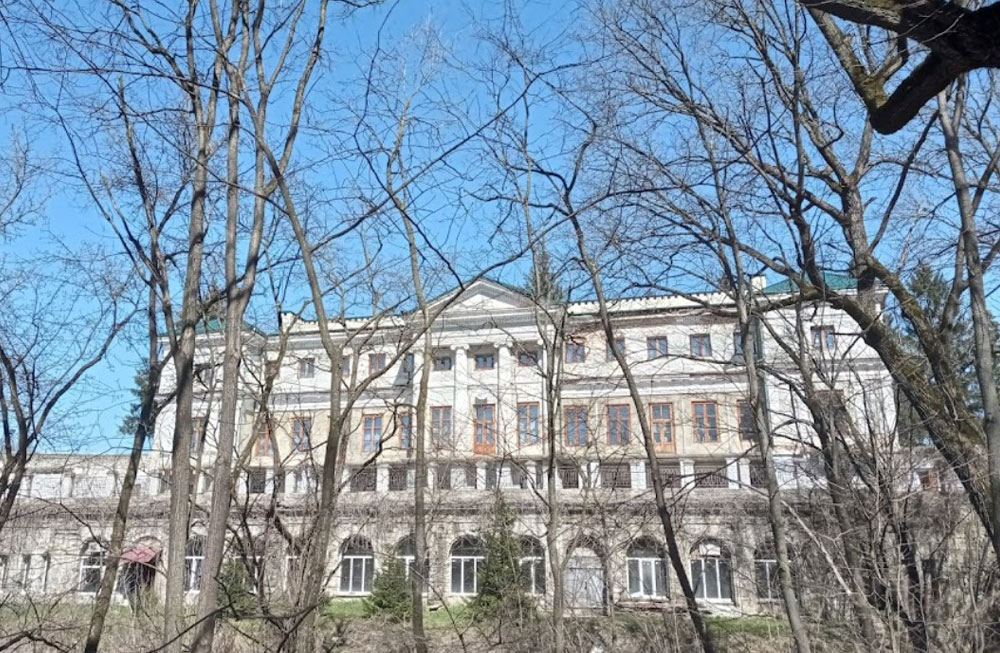
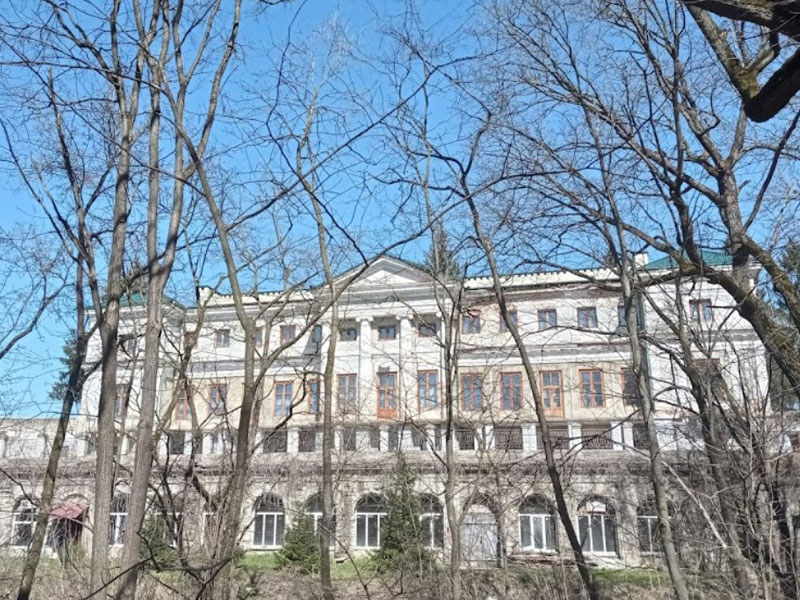
Komar Palace in the urban-type settlement of Murovani Kurylivtsi is one of the most distinctive historic estate locations in Vinnytsia region, where a classicist residence, traces of an older fortified site, a park environment, and the relief of the Zhvan valley come together in one ensemble.
For a visitor, the value of the place is not limited to its main facade. The site clearly shows the transition from a castle-based past to an early nineteenth-century palace residence, and it also demonstrates how a historic complex continues to exist through later functional reuse.
Within a Vinnytsia region itinerary, this location works best in a slow-travel format: a measured walk around the ensemble, observation from several viewpoints, and a combined visit with other places in and around Murovani Kurylivtsi.
Murovani Kurylivtsi
Vinnytsia region
palace and estate complex
classicism
castle escarpment
park landscape
Zhvan River
cultural heritage
green travel
weekend route
Overview of the site
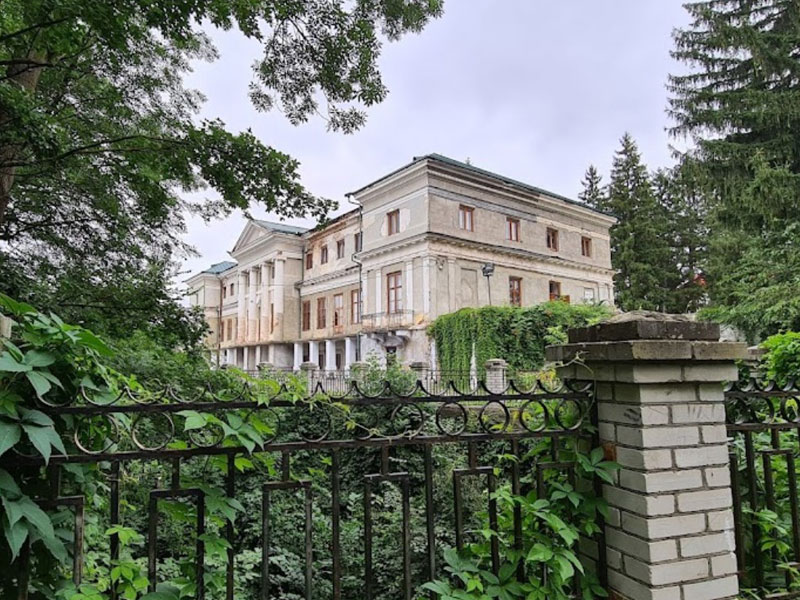
Komar Palace is a historic residence in Murovani Kurylivtsi, officially documented as a monument of architecture of national significance dated to 1805. The complex is notable not only as a surviving palace building, but as a layered historic site where the residence is tied to an earlier fortified core and to the dramatic landscape above the Zhvan River valley.
The place is especially well suited to travelers interested in local history, estate architecture in Podillia, unhurried cultural trips, and photography based on space and landscape rather than on entertainment infrastructure. A basic visit usually takes about 45 to 90 minutes, while a slower walk around the ensemble and nearby settlement landmarks may require more time.
For a weekend route across Vinnytsia region, the palace is a strong cultural stop. It does not compete in scale with the region’s largest palace complexes, but it stands out through the combination of a classicist composition, a castle-based foundation, a partially preserved landscape park, and a visually strong Podillian setting.
Photos
History
Origin of the site
The story of the location begins earlier than the palace itself. Local and heritage sources describe the residence as having been built on the basis of older fortification structures, with the sixteenth-century fortified site of Churyliv regarded as the deeper historical layer behind the ensemble. This gives the palace a different reading from that of a standalone manor house built on an empty plot.
Owners and historical context
The palace is associated with Stanislaw Delfin Komar, Marshal of Podolia, who chose Murovani Kurylivtsi as a residence and is linked in the sources to the construction of the early nineteenth-century palace. The complex also belongs to the broader history of the Komar family and to the landed culture of Podillia at the turn of the eighteenth and nineteenth centuries.
In historical accounts connected with the estate, the palace also appears in relation to Delfina Komar, later Potocka. This adds a personal and dynastic dimension to the site, although the palace is more important as an architectural and spatial ensemble than as a single-family biographical monument.
Further fate and current condition
Over the twentieth century, the estate lost its private residential role and was adapted to institutional use. Official local materials note its later use for an educational institution, while the regional heritage passport records the building as a monument of architecture of national significance at 1 Sportyvna Street.
Today the complex preserves its main volume, the connection to the older fortified base, and part of the estate environment, but it also bears traces of later rebuilding and long-term practical use. For a visitor, this is less a fully museum-restored palace and more a historically charged site whose value lies in the ensemble, relief, and continuity of place.
Architectural features
Layout and composition
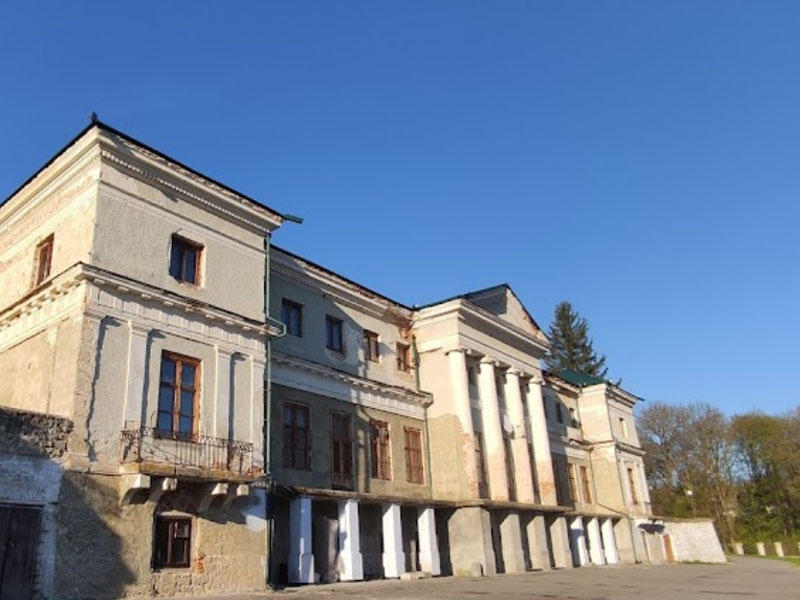
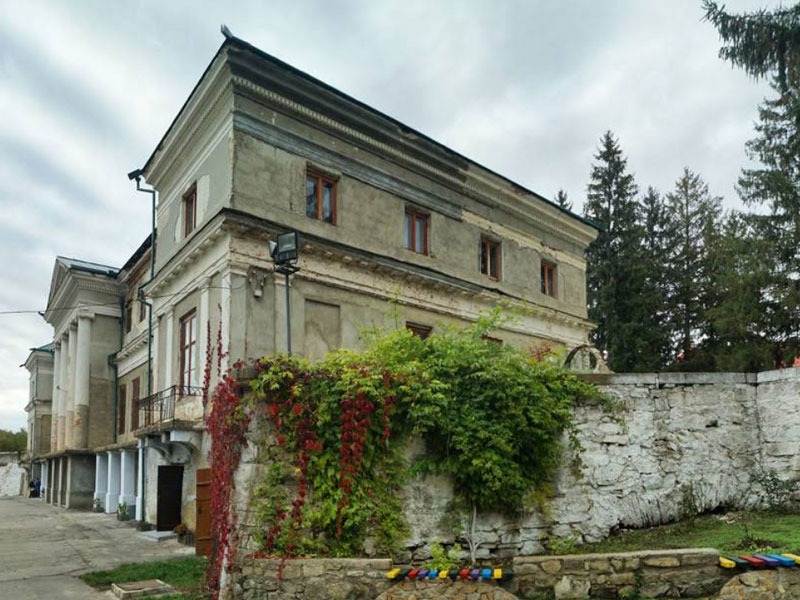
The palace gains much of its expressiveness from the terrain. From the courtyard side the composition appears relatively restrained, while from the park and slope side it reads as far more monumental. The inclusion of the older castle escarpment and stone retaining structures makes the ensemble unusual within the broader group of Podillian estate residences.
Stylistic features
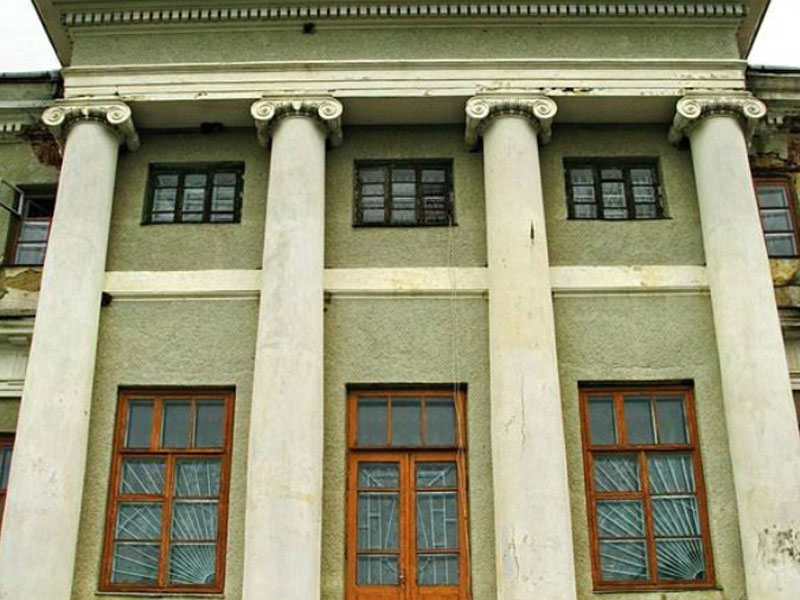
In architectural character, the building is a classicist palace with a symmetrical composition, a clear central axis, and a representative main frontage. What makes it especially interesting is that these classicist features are superimposed on an older defensive foundation, so the palace is read both as a residence and as a reworked fortified site.
Heritage and travel descriptions also mention other surviving estate elements, including an outbuilding in Neo-Gothic forms, a former stable or arsenal building, and a stone three-arched bridge across the Zhvan River. These features strengthen the reading of the place as a broader estate landscape rather than a single isolated facade.
State of preservation
The principal building volume survives, but the degree of authenticity in individual details has been affected by long non-museum use and later alterations. Even so, the silhouette, terraced siting, masonry base, and relationship to the valley remain the key carriers of the site’s historic value.
Natural surroundings
Park and landscape
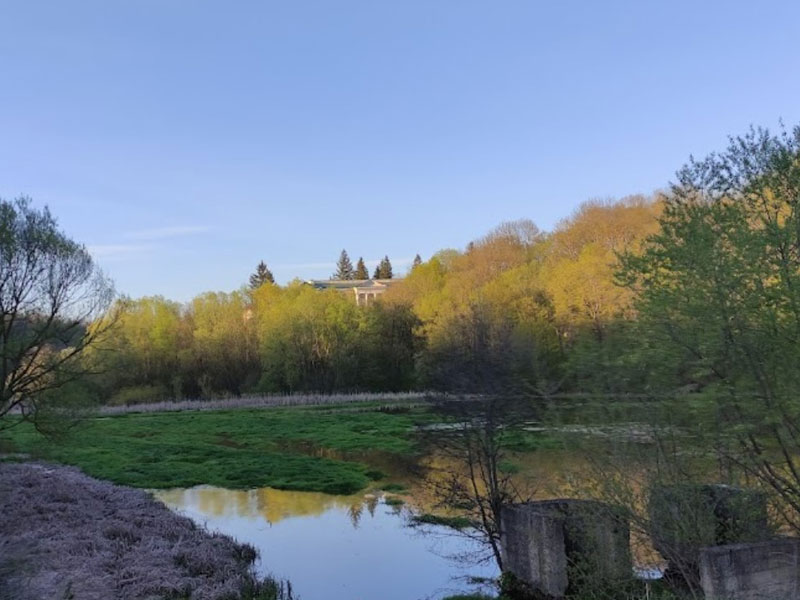
The palace stands in a strong landscape setting above the Zhvan River valley. Sources about the estate connect it with a landscape park whose development in 1814 is associated with the Irish landscape designer Dionysius Mikler. The park survives only in part, yet it still plays an essential role in how the ensemble is perceived.
Appeal for walks and photography
This is a location that rewards movement and changing viewpoints. The most interesting visual experience comes not from one frontal shot but from the sequence of perspectives created by the slope, the stone walls, the river setting, and the different elevations around the palace grounds.
Importance for green tourism
Komar Palace fits naturally into a green-travel or slow-travel route. Its appeal depends on the combination of history, architecture, walking, and landscape rather than on a dense concentration of attractions or entertainment services.
Tourist infrastructure
How to get there
The main navigation point is Murovani Kurylivtsi, 1 Sportyvna Street, Vinnytsia region. The site is easiest to include in a regional road trip, though it may also be reached by public transport to the settlement followed by a short local approach.
What to know before visiting
This is not a standard museum location with fully predictable visitor infrastructure. Because the monument has had ongoing practical use, access conditions may depend on the actual status of the territory at the time of visit. It is best to treat the place as an active historic site: respect closed areas, avoid assuming open interiors, and check current access conditions in advance.
How to combine it with other locations in Vinnytsia region
Within Murovani Kurylivtsi itself, the palace can be combined with a walk through the historic settlement environment and viewpoints toward the Zhvan valley. Within a wider regional route, it pairs especially well with other Vinnytsia region palace and estate locations such as Tulchyn, Voronovytsia, and Nemyriv, but it works as a smaller-scale and more landscape-driven stop.
Expert analysis
The main strength of Komar Palace is not a perfect level of restoration. Its real value lies in the coexistence of several historical layers within one readable space: a fortified base, a classicist residence, traces of a landscape park, and the natural frame of the Zhvan valley. That gives the site a high interpretive value for travelers who want to understand how a place evolved, not simply photograph a facade.
Compared with better-known palace stops in Vinnytsia region, Murovani Kurylivtsi offers a more more intimate, landscape-oriented experience. It is especially strong as a calm cultural detour, a photography stop, and a meaningful part of a slow-travel route across Podillia.
Comparative table with other locations in Vinnytsia region
| Site | Settlement / community | Type of location | Historical period | Architectural expressiveness | Natural surroundings | State of preservation | Tourist value for a Vinnytsia region route |
|---|---|---|---|---|---|---|---|
| Komar Palace | Murovani Kurylivtsi | Palace and estate complex | 1805, on an older fortified base | Classicist residence tied to a castle escarpment and terraced siting | Zhvan valley, partial park remains, strong relief | Main volume preserved, later alterations visible | Very strong for a thoughtful cultural stop, photography, and slow travel |
| Potocki Palace | Tulchyn | Large palace complex | Second half of the eighteenth century | One of the major classicist palace ensembles in the region | Urban palace grounds | Major landmark with high recognition | Flagship stop for a palace-oriented regional route |
| Grocholski-Mozhaysky Palace | Voronovytsia | Palace and museum site | Eighteenth century | Representative classicist estate architecture | Park environment within a settled locality | Restored and actively used as a cultural site | Strong stop for travelers combining heritage and museum interest |
| Princess Shcherbatova Palace | Nemyriv | Palace and park complex | Late nineteenth to early twentieth century | Later palace architecture with a visually prominent ensemble | Large park setting | Recognizable historic complex, valued as a tourist landmark | Strong for a longer cultural and park-focused route |
FAQ
Where is Komar Palace located?
The palace is located in Murovani Kurylivtsi, Vinnytsia region. Official heritage materials list the address as 1 Sportyvna Street.
Why is this place interesting for travelers?
It combines a classicist palace, the remains of an older fortified base, a partial landscape park, and a strong river-valley setting. It is best appreciated as a historic ensemble rather than as a single facade.
When is the best time to visit?
Spring, summer, and early autumn are the most comfortable seasons for reading the landscape and park setting. Soft daylight and dry weather are especially useful if photography is one of your goals.
How much time should I plan for the visit?
A basic visit usually takes around 45 to 90 minutes. If you want to walk around the ensemble and add other stops in Murovani Kurylivtsi, plan more time.
Is the palace suitable for photography?
Yes. The best results usually come from varied viewpoints: the courtyard side, the slope, the fortified masonry base, the approaches near the bridge over the Zhvan, and wider views of the ensemble in the landscape.
Can this stop be combined with other places in Vinnytsia region?
Yes. It works well within routes focused on palaces, estates, and historic towns of the region, especially in combination with Tulchyn, Voronovytsia, or Nemyriv.
Is it worth making a special trip here?
Yes, especially if you value quieter heritage sites with a strong sense of place. If your priority is a fully museum-adapted palace with extensive visitor services, it is better to set expectations more carefully.
Sources
- Vinnytsia regional heritage passport: Palace in Murovani Kurylivtsi
- Mohyliv-Podilskyi district administration: Palace of Podolian Marshal S. Komar
- Polish Institute in Kyiv / Polonika: Murovani Kurylivtsi Palace
- Travels in Ukraine: Komar Palace, Murovani Kurylivtsi
- Tulchyn community tourism page: Potocki Palace
- Voronovytsia community: Grocholski-Mozhaysky Palace
- Travels in Ukraine: Princess Maria Shcherbatova Palace, Nemyriv
Video review
Location on the map